sábado, 3 de marzo de 2012

SEISMIC RISK: URBAN ORDINANCES IN SPAIN CONSIDER GROUND AS A LAND SURFACE, NOT AS A VOLUME


0. INTRODUCTION

Nowadays cities are very complex and interdependent systems, they are extremely vulnerable to threats from natural risks. The very features that make cities feasible and desirable (their architectural structures, population concentrations, places of assembly, and interconnected infrastructure systems) also put them at high risk to floods, earthquakes, hurricanes, landslides, and even terrorism. Worldwide we feel the need to reach an advanced planning that leads us to specific actions into the philosophy of reducing those risks through the only available way: a development of resilient cities based on the adequate knowledge of the ground and its interaction with buildings, both of them molding a vulnerable system where we live in, which is very weak when a natural hazard occurs. Are we really sure of our correct knowledge of this system?

We are more than 7,000 million people. By the year 2020 more than 5,500 million people will live in cities, with a new world of relationships, this means more than our entire 1990 combined rural and urban population moving essentially through cities. The growth of these urban agglomerations is a new experiment for life on Earth. Tragically, a significant fraction of these agglomerations are located in Europe and especially in Spain close to regions of known seismic hazard.


L'AQUILA 2009
Recent earthquakes (Mw>5) have spared the Spanish and European major urban centres, but this will not persist indefinitely, examples of their potential severity being the Albolote, Santa Fe and Atarfe earthquakes in Granada Mw 5,1 of 1956, also Assisi 1997 and the Mw 5.8 L'Aquila earthquake of 2009 in Italy, and the most recent Lorca Mw 5.2 earthquake of 2011. In coming years several more cities will be damaged by significant earthquakes. We are most certain of the fate of those cities near plate boundaries, however, mid-continent earthquakes also occur, although less frequently. 


In 2007 a seismic movement Mw 5.1 struck Pedro Muñoz (Ciudad Real) far from any big city; only the rooftop of the Almagro Theatre collapsed. This mid-continent earthquake of only 5.1 was so close to the land surface that it was felt in the whole of Iberia, including Spain and Portugal. Madrid (200 km) and also Asturias (600 km) were witnesses to it. If such an event had occurred close to a city, consequences would have been comparable to those of Atarfe, Albolote, l'Aquila or Lorca, but consulting the Spanish seismic information map (below), the village of Pedro Muñoz is indicated in the NCSE 02 as a non-seismic location, situated just in the middle of Iberia, with a basic expected acceleration less than 0,04g. This event showed the current state of our knowledge concerning faults, their location, activity, and the potential damage they are capable of generating.


One of the most intractable problems in saving future lives from earthquakes in the developing and some developed nations is the prevalence of corruption in the building industry. In last recent years Spain developed the highest degree of corruption ever seen in Europe; lots of places became vulnerable to seismic hazards due to the incorrect knowledge of the ground, and these wild episodes of building activity also resulted in cities growing into highly vulnerable geological sites.

1. GREAT FAULTS, SMALL FAULTS AND CODES

Urban ordinances are tools by which many municipalities are organized physically. Their main objective is to regulate the use of land in a beneficial way to their inhabitants, and also to be an efficient guarantor of all the inner activities and their interrelationships. Urban regulations in those cities located in seismic zones like the many there are in Southeast Spain, usually do not include special seismic provisions and are very similar to those located in non-seismic prone areas. The seismic-resistant design and construction structural code in force is NCSE 02. This is a result of the revision of the former NCSE 94 that substituted the PDS-1/1974. This, in turn, had only been preceded by the first Spanish seismic-resistant standard, dating from 1968, PGS1.

That code did not include a seismic risk map, but referred to the one in MV 101, the building loads code in force at that moment. NCSE 02 is based on previous knowledge and includes the analysis of the most relevant earthquakes registered in Spanish history. It also applies new criteria and the lessons learnt from the latest destructive earthquakes of Mexico (1985), Armenia (1988), Loma Prieta (1989), Kobe (1995), Izmit (1999) or Taiwan (1999) considering also, the rest of the European (Eurocode 8) and international standards, that have also been revised and renewed recently.

We must underline the importance of the 1755 Lisbon earthquake on the design of these standards, rather than the smaller seismic measured events coming from faults less deep but very close to the cities, some of these faults are less than 4 km long, but capable of killing people, as well as injuring and devastating cities. The last quakes like those in Granada, Albolote, Atarfe, La Paca, and Lorca, show that damages were always concentrated in the towns that are close to one of the most active faults related to seismic zones of the Iberian península.


THE 1755 LISBON EARTHQUAKE AND TSUNAMI (8,5-8,8)
Although we can't exclude the possibility that these direction faults could cause earthquakes of greater magnitude than 5 or 6, we have shown that the formation of small tectonic structures helps to partially relax the energy associated with the convergence of plates, and reduces seismic activity in larger faults like Azores-Gibraltar Fault, but we are not ready if we let our hope lie only on seismic codes; they are not enough because they are designed only for the individual pieces of the system: the buildings. Nine million years ago, the eastern part of the Baetic mountain range was deformed by numerous folds and faults, caused by the collision of the Eurasian and African plates. Lots of them are active and hidden.

Urban regulations determine the building’s volume enclosure without any anti-seismic resistant design planning. They consider earthquakes acting on single pieces of the system (buildings) rather than on the real seismic scenery: the city. Damage in one isolated building due to earthquake effects may not just affect the people who are inside but people passing by, the neighboring buildings, and the surrounding environment too. As we saw in La Paca in 2005 and in Lorca in 2011, the absence of these regulations means chaos in the city. Murcia, Andalucia and the Levante are areas of seismic risk. So they should have been prepared. As we saw last May, an earthquake collapsed the fronts of buildings and ripped open walls. Streets were littered with crumbled buildings, chunks of masonry, fallen terraces and crumpled cars. 

It is necessary to inform and instruct architects and city planners on the consequences of their urban planning and architectural decisions, since they (city planners and official entities) should share with structural engineers the great responsibility of mitigating seismic risk and of reaching seismic resilience in Spanish cities. It is essential to convince city officials, urban planners and decision takers of the urgent necessity of revising urban ordinances on seismic places all across our geography. The NCSE 02 map establishes a zonification for the basic acceleration values, the basis to obtain the design seismic acceleration, fundamental data required to design any seismic-resistant structure. The basic acceleration corresponding to Lorca is 0.12g, with Granada and Alicante being the zones with the highest values: over 0.16g.
 
A deep geological (fault situation, peleoseismicity...) and architectural (technical inspection of buildings) study is needed, however, a study in itself, has never saved a life or prevented property damage; studies are only effective when their results and recommendations stimulate actions that mitigate the effects and consequences of future disasters. Central and regional governments, and municipalities must now take action.

Will Spain always be in the situation that Lorca is in now? Aware of looming catastrophe but taking no action to prevent it? Or does Spain have the political will and courage to invest in its future by retrofitting the many known seismically vulnerable historical cities with regards to buildings and land? Such investment will cost building owners in the short term, but will reap many benefits in the long term, both for the owners and the community at large when strengthened buildings continue to function as safe homes and sources of continued revenue in the aftermath of a major seismic event. Inaction is inexcusable in light of the peripherical known vulnerability and the fact that most of these risks are avoidable with an adequate urban planning based on a correct knowledge of the physical environment.


NCSE 02 IS ONLY A STRUCTURAL CODE DESIGNED FOR EACH INDIVIDUAL PIECE OF THE SYSTEM: THE BUILDING. BUT THE REAL SCENERY OF THE SEISMIC EVENT IS ALWAYS THE CITY. THE 3D GROUND EFFECT IS NOT CONSIDERED ENOUGH IN NCSE 02, BUT IT IS STILL LESS CONSIDERED IN URBAN ORDINANCES THAT CONTEMPLATE GROUND AS A SURFACE RATHER THAN A VOLUME WITH DISCONTINUITIES, IRREGULARITIES, AND FAILURES. 

The top basic acceleration value in Spain is in the town of Santa Fe in Granada: 0.24g. In spite of this, the latest harmful seismic movements in Spain have been located in the region of Murcia, that suffered five important seisms in the last twelve years: Mula (February, 1999), Bullas (August, 2002) y La Paca (January 29th 2005, magnitude 4.4 Mw, 40 km away from Lorca). And, unfortunately, as with the last two in Lorca (May, 2011), all of them were related to the FAM. The seismic design acceleration obtained by multiplying the basic acceleration by the rest of the parameters included in the NCSE 02 (four coefficients: contribution k = 1.00, ground C =1.61, risk r =1.00 and ground amplification, S =1.27) is 0.15g in Lorca, clearly less than the maximum instrumental basic acceleration registered, 0.41 g.

SOUTHEASTH IBERIA BIG FAULTS

This kind of movement is usual in these circumscriptions, but the fact that the hypocentre was so superficial and the epicentre so close to Lorca was crucial for the disaster. The crust structure in Murcia, like in the rest of the southeast of Spain and in the area of Pyrenees, is similar to an assembly of domino pieces horizontally laid: when one of them moves, all the others are affected.

The study of old earthquakes through the marks left on the sediments is the paleoseismicity. In Spain there are only a few studies of paleoseismicity and most parts of them are concentrated in the Southeast. The rest of the territory lacks of it.

MAP OF THE PALEOSEISMICITY STUDIED IN IBERIA: ONLY THE  SOUTHEAST TERRITORY AND CATALUÑA SHOW A FEW STUDIES OF THE LAST MIOCENIC-PLIOCENIC AND QUATERNARY SEISMIC ACTIVITY
2. THE REALITY OF THE GROUND: A VOLUME, NOT A SURFACE

Nowadays, decision making in Master Urban City Plans is based on studies and maps: flooding risks and topographic maps and noise and urban mobility studies. Paradoxically, in urban planning, ground is considered as a land surface ignoring the volume under the sub-surface, whose mechanical nature in seismic areas is capable of doubling or even tripling the power of seismic waves, like in the historical town of Lorca, especially the La Viña district with its quaternary materials cuvette, the same under Albolote, Atarfe or Santa Fe in Granada.


THE 3D GROUND EFFECT AS AN  ECHO CHAMBER AND AMPLIFIER OF SEISMIC WAVES IN TOKYO CUVETTE

An example: Lorca is on the axis of the FAM (Alhama de Murcia Fault). Both seismic movements that occurred on May 11th were very superficial (2 km depth): the first (4.5 Mw) two hours before the second (5.2 Mw) was only 3 km NE from town centre. This also explains the high number of minor events registered months after the two main events (more than 300), identified across the segments in which the FAM is divided into. This is a transcendental question because similar configurations may exist not only in the region of Murcia but also in many other regions in Southwest Europe, such as Navarra, the Basque Country, Aragón and Cataluña, in Spain and their counterparts on the North side of Pyrenees: in French Departments, Pyrenées Atlantiques and Orientaux.

It is also important to underline the fact that Murcia is a very rich geotechnical site, concerning the soil textures and specimens. Underneath Lorca the Guadalentín River and all its sediments form a cuvette capable of amplifying the seismic waves, as seen. Granada, Albolote, Santa Fe, and Atarfe are in a similar situation with the Genil River. Due to the fact that part of these materials can be qualified as collapsible, the consequences of another magnitude 5 or 6 event are difficult to foresee.

3D GEOLOGICAL STRUCTURE AND MOVING MATERIALS UNDER SOUTHEAST IBERIA

The year before the earthquakes struck Lorca, the FAM was in an inter-seismic period with no activity at all. Thus, it was quite predictable, with obvious limitations, that something was going to happen; some tectonic experts even announced it, as is the case of Professor Tomás Rodriguez (University of Cartagena). The real unexpected issue was not the earthquake itself but the top basic acceleration that was generated: 0.41g. This was more than 3 times the expected value (0.12g). There is no doubt that among other questions an amplification phenomenon happened. Are the C, k, S coefficients or the other of our capricious inventions, responsible of it? Or certainly we don't have the correct 3D mental-picture of the real nature of the ground under our feet? Is the ground under Lorca smart enough to be "aware" that its coefficients are: k=1, C=1.61, and S=1.27, or does it simply not care?

LORCA MAY 11 2011, A COMPLETE SYSTEM DAMAGED


THANKS TO MARCO FOR THE HELP

VARA BLANCA DE HEREDIA: RESILIENCIA CON SABOR A FRESAS SIN INGREDIENTES ARTIFICIALES

VARA BLANCA DE HEREDIA, UN LUGAR PRIVILEGIADO RECORRIDO POR FALLAS

1. INTRODUCCIÓN

Uno de los ejemplos de resiliencia en los que la comunidad por sí sola encuentra un camino con muy pocos recursos y apoyos, pero con mucha voluntad, imaginación y entrega, lo tenemos en Vara Blanca de Heredia, en el cantón nº 1 de Heredia, en Costa Rica. En enero de 2009 un terremoto de escala 6,2 sacudió todo el país de Costa Rica, y afectó también en menor medida a Nicaragua y Panamá, el epicentro se localizó en esta zona; hoy ya todo el mundo lo conoce como el terremoto de Cinchona. Casi 130.000 personas perdieron sus casas, sus trabajos, o de alguna manera se vieron afectadas, algunos vieron morir o desaparecer a sus seres queridos, los fallecidos no se supieron con seguridad pero se estimaron en cerca de 30.

LOS FAMILIARES Y AFECTADOS LLORAN A SUS VÍCTIMAS EN UNA COMUNIDAD GOLPEADA, 2009


CONCURSOS, PROPUESTAS,  PRIMERA FIESTA 2010
Después de no mucha ayuda oficial y varios intentos de potenciar la artesanía, talleres variados y otras iniciativas con poco éxito, la comunidad local desarrolló una propuesta que ya tiene una proyección nacional basada en uno de los más abundantes y mejor conocidos productos naturales locales: las fresas.

Así es como se generó la ya famosa Feria de las Fresas, una fantástica iniciativa fundamentada en el cultivo ecológico de la fresa y la elaboración de productos basados en ella, una idea viva que ya ha aportado un notable incremento en la riqueza local, el empleo, las infraestructuras, los transportes, etc.,  y en tan solo tres años después de la tragedia, un proyecto que ya se ha hecho famoso en todo el país.

Consolidar los criterios de calidad y ligar el conjunto de productos a una imagen corporativa basada en la ecología, la salud y la calidad es una plausible joven empresa que ya está iniciada. Ojalá tenga los apoyos necesarios para llegar a buen puerto y no caer en las codiciosas manos de especuladores locales, el peligro de brillar con éxito podría "matar a la gallina de los hevos de oro" estamos acostumbrados a verlo.


LA CATARATA DE LA PAZ  "EL ÁNGEL"


El Cantón de Heredia estuvo habitado por poblaciones indígenas del Reino Huetar de Occidente. El régimen constitucional comienza con la Constitución de Cádiz de 1812, primera que rigió en Costa Rica, el primer Ayuntamiento o municipalidad de Heredia se instaló el 19 de mayo de 1812. En 1813, por gestiones del Diputado costarricense Florencio del Castillo Villagra, las Cortes españolas concedieron a Heredia el título de villa, pero en 1814 fue anulado, como consecuencia de la decisión del rey Fernando VII de dejar sin efecto todo lo actuado por las Cortes. En 1820, poco después de restablecido el régimen constitucional, una ley de las Cortes hizo que Heredia recibiera por tercera vez el título de villa. En agosto de 1835, Heredia se convirtió en sede de los Poderes Legislativo y Conservador y capital del Estado de Costa Rica, aunque los Poderes Ejecutivo y Judicial fueron ubicados en la ciudad de San José. 


Heredia conservó la condición de capital de Costa Rica hasta 1838, año en que el Jefe de Estado Braulio Carrillo Colina, concentró todos los poderes en San José. En 1848 la Constitución Política estableció los títulos de Provincia, Cantón y Distrito Parroquial. 


2. EL TERREMOTO DE CINCHONA


EFECTOS EN VARA BLANCA


El 8 de enero de 2009 un terremoto en Costa Rica sacudió Cinchona, y ya es conocido popularmente como el terremoto de Cinchona ocurrió a las 13:21 hora local y tuvo una magnitud de 6,2. El terremoto de enero de 2009 se generó a unos 9,7 kilómetros al este del Volcán Poás, según el Observatorio Vulcanológico y Sismológico (OVSICORI) y la Red Sismológica Nacional (RSN) costarricense. Los daños fueron numerosos.


EL VOLCÁN POÁS, UNO DE LOS ATRACTIVOS TURÍSTICOS DE LA COMARCA, TAMBIÉN PRESENTÓ ACTIVIDAD DESPUÉS DEL TERREMOTO DE 2009, LA BELLEZA Y LA FUERZA DE ESTA TIERRA MIMA Y CASTIGA AL MISMO TIEMPO A ESTA COMUNIDAD,

El terremoto fue originado por una falla identificada como la Falla de Vara Blanca, cuya última actividad fue en junio de 2005. Un día antes el miércoles 7 de enero esta falla generó un sismo premonitor de 4,2. La zona es conocida por su actividad sismológica y vulcanológica, su atractivo turístico se basa entre otras cosas en la fuerza y la belleza de semejante peculiaridad, también la que de vez en cuando se cobra su factura.

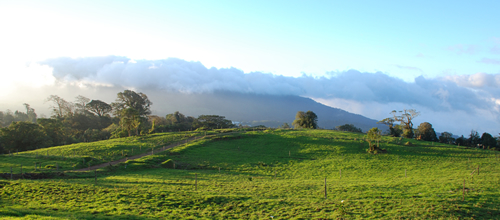
VARA BLANCA ANTES Y DESPUÉS

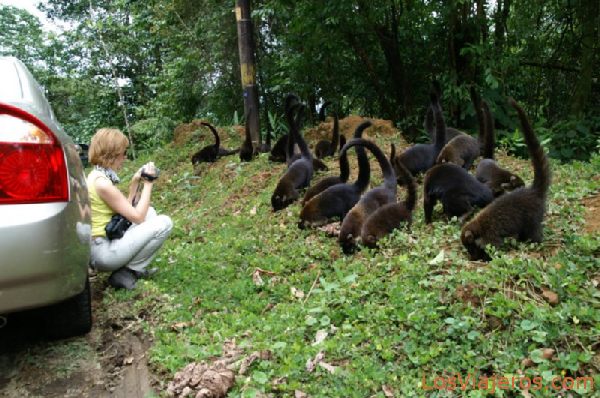
COATÍES CERCA DE LA CATARATA DE LA PAZ

La cifra de muertos que se maneja es cercana a 30. Se reactivó otra falla y se registró otro seísmo que llegó a los 4,1 grados, ésta es conocida como  la Falla de Toro Amarillo. Además, el volcán Poás comenzó a registrar pequeñas erupciones. El gobierno hizo una llamada urgente a toda la comunidad internacional para afrontar la emergencia tras el terremoto.


El presidente de Costa Rica, Óscar Arias, estimó que el número de afectados ascendía a más de 128.000 personas. Ante esta realidad, el gobierno costarricense solicitó la cooperación mundial por medio de la Oficina de Coordinación de Ayuda Humanitaria de las Naciones Unidas (OCHA), cuyo equipo de especialistas se hizo presente en el desastre desde el 9 de enero.


LA CATARATA DE LA PAZ, O EL ÁNGEL, DESPUÉS DEL TERREMOTO

El terremoto de enero de 2009 sacudió a todo el Valle Central costarricense, principalmente a las provincias de Heredia, Alajuela y San José y se sintió hasta el sur y centro de Nicaragua y el norte de Panamá. El epicentro se ha situado a 30 kilómetros de la capital San José. La falla Vara Blanca-Ángel fue la que originó el terremoto y es considerado como el de mayor magnitud en los últimos 160 años en esa zona, se han venido dando otros con magnitudes entre 5,7 y 6,0 grados. La falla tiene una extensión de aproximadamente 20 kilómetros.


3. EL PODER DE LAS FRESAS SIN INGREDIENTES ARTIFICIALES


Hoy Vara Blanca era y busca volver a ser un destino turístico de primera calidad, en camino está el  recuperar las cifras de visitas anteriores a 2009, el turismo se basa sobre todo en su riqueza natural, geológica y biológica; sus rocas volcánicas, su fauna y su flora conforman un área muy bella y singular. Es destacable la famosa Catarata de la Paz, conocida en toda centroamérica, seriamente dañada después del sismo. 

¡QUÉ MEJOR QUE ACOMPAÑADAS CON PRODUCTOS DE LA COMARCA!
Pero Vara Blanca intenta recuperarse del golpe que supuso para sus infraestruturas y modo de vida aquel acontecimiento, quedó aislada un tiempo y los helicópteros aportaron medicinas, alimentos, tiendas, ropa, etc.

Vara Blanca de Heredia fue una de las zonas más afectadas por el terremoto de Cinchona en enero del 2009. Este pueblo ha ido saliendo adelante poco a poco y sus increíbles paisajes también, dejando atrás momentos de amargura, dolor y destrucción.

La Feria de las Fresas, que se realiza en esa zona, nació con la brillante idea de brindarle a este pueblo la oportunidad de comercializar sus productos y abrir nuevas formas de negocios para sus habitantes.

PREPARADAS PARA CONCURSAR, PREMIOS AL TAMAÑO, SABOR...


Rafael Rojas, productor de fresas y encargado de la feria, dijo que después de que pasó el terremoto, varias personas del lugar recibieron talleres y aprendieron a hacer artesanías, pero no tenían un lugar para poder venderlas.


“Después de lo que pasó con el terremoto fueron dos años que la gente se estuvo levantando; y estamos un poco abandonados por la gente del gobierno, entonces la intención con la feria es que las señoras de la comunidad tuvieran dónde vender sus cosas e iniciamos con esa intención de levantar la comunidadTenemos que empezar a crecer solos y vamos para adelante, Vara Blanca no ha muerto. La comunidad tiene que levantarse”. Rafael Rojas.

HAY MUCHAS VARIABLES PARA DISFRUTAR

En Vara Blanca existen alrededor de dos millones de plantas de fresa. En esta zona, los habitantes están dedicados a la producción de leche y especialmente de fresas. Elver Morera, productor y miembro organizador de la feria, indicó: “... una de las principales características aquí con la producción es que todo lo tenemos en cielos protegidos, no sembramos al aire libre porque eso significaría costos más altos y aparte eso sería usar químicos que nosotros tratamos de producir con un estándar muy bajo; tratamos de producir orgánicoLa construcción de las camas donde están las fresas las hacemos a pura pala. Después de que se siembra la planta (el hijo) duran dos meses y 15 días y ya están produciendo, aquí hay varios productores que entregan directamente con varios supermercados”. En la feria, además de conseguir las fresas frescas y muy baratas, se puede disfrutar y adquirir toda serie de artesanías locales y productos elaborados por los miembros de esta hermosa comunidad. Además de disfrutar de estar en una de las zonas catalogadas por la UNESCO como Patrimonio de la Humanidad y con casi un 20 % de territorio catalogado como Reserva de la Biosfera.


COSTA RICA, RESERVA DE LA BIOSFERA, PATRIMONIO DE LA HUMANIDAD

jueves, 1 de marzo de 2012

RISK MANAGEMENT IN SPAIN SHOULD BE A TRANSDISCIPLINARY RESEARCH: IDENTIFIED VULNERABILITIES AFTER THE SEISMIC EVENTS IN LORCA

0.  INTRODUCTION

Spanish building sector professionals are not still aware of the fact that Spain is a seismic country. Urban regulations determine a building’s volume enclosure without any seismic resistant design planning. They consider earthquakes as acting on single pieces of the system: buildings, rather than on the real seismic scenery: the city.

Worldwide, seismic building codes are written for engineering application, rarely accompanied by guidelines related to architectural or urban features, even modern cities enforce the use of certain irregular building configurations such as set-backs, soft first stories, adjacencies, etc (1).

Experience indicates the well known high vulnerability of these configurations but they are still present today worldwide. Every time an earthquake strikes a contemporary city, reports about the damage show that these configurations are not recommended in seismic places, but nobody pays attention. The first stories of buildings are mostly used for social events, parking, commercial and business purposes, and other activities that require layouts free of walls (2).

Our modern lifestyle also means an increase of movement and speed; maybe we are now living on a non seismic area, but sooner or later, be it working, visiting, enjoying holidays, or otherwise, we will put our feet down on a seismic location. Are we really ready to do it? The answer is NO! L'Aquila and Lorca are witnesses to it.


1. INCORRECT URBAN PLANNING

Urban regulations in cities located in seismic zones, as Lorca is in Spain, usually do not include special seismic provisions, and are just the same as those located in non-seismic-prone areas. The NCSE02 code needs urgent revision: nine people died in Lorca, none of them due to structural collapses. Geotechnical matters such as the influence of local ground amplification should be reconsidered. Buildings with reinforced concrete structures but with set-backs, short columns, ground soft story, or incorrect anchoring of the non-structural elements, are examples of existing architectural configurations unsuitable for a correct seismic behaviour, and lots of cities worldwide are in the same situation. The earthquake that ravaged the Italian town l’Aquila evidenced that other European areas share the same risks.

2. NEW INSPECTIONS OF HERITAGE STRUCTURES ARE NEEDED


SANTA MARIA DE LAS HUERTAS SANCTUARY SERIOUSLY DAMAGED

Damages to the rich heritage of medioeval and baroque buildings in Lorca, evidence the need for specific inspections to determine their structural vulnerability, as well as the implementation of new reinforcement technologies.  Special urban planning for those historical centre towns close to active faults is also required, but not only in Spain, Mediterranean Europe is still in an especially dangerous situation with respect to seismic events.
SANTA MARIA DE LAS HUERTAS SANCTUARY SERIOUSLY DAMAGED


Actions should be taken in order to prevent similar effects in historical places with the same tectonic situation: Granada, Córdoba, Murcia, Alicante, Torrevieja..., which are potentially laying on the same risks: closer active faults, on grounds capable of doubling or even tripling the power of seismic waves.

SANTA MARIA DE LAS HUERTAS SANCTUARY
Spain is the country with the second most important number of National Heritage sites in the world, behind Italy and ahead of China. It seems both appropriate and necessary to make an investment in the future of Spain, one of the most important countries in the World regarding cultural tourism and still not developed  enough. Sadly some of our leaders still are unaware of it. Spanish Heritage (historical, artistic, architectural, landscape, gastronomic and so on) should be promoted to the highest post in the scale of priorities, those regions with the most important cultural or historical richness should be provided with special plans related to seismology and heritage preservation. Possibly, one of the most ambitious tasks to assume in future days may be the reinforcement of churches, palaces, convents, castles, etc., like those now painfully damaged in Lorca, as well as to foresee their behaviour during an earthquake, like the one that shook Lorca, on Wednesday, the 11th of May.


LORCA: THE MORE DENSE BAROQUE CONCENTRATION IN EUROPE, THE WORST CULTURAL HERITAGE DISASTER IN EUROPE SINCE THE 1997 EARTHQUAKE THAT STRUCK ASSISI IN ITALY


3. PEOPLE IN EUROPE ARE NOT TRAINED FOR SEISMIC EVENTS


ARE PEOPLE IN EUROPE PREPARED ?
THE ANSWER IS: NO!
On the other hand, people in Europe and especially Spanish people are not prepared or trained for an adequate behaviour during seismic events, as they are in Japan, California or South America. The application of seismic building codes has not been, is not, and it will never be sufficient. It is necessary to develop and implement a multidimensional and interdisciplinary approach. But also a transdisciplinary one to develop a new approach, adequate tools, processes and mechanisms to reduce the seismic vulnerability in European cities situated close to active faults, with the participation of geologists, city planners, engineers, architects, constructors, stakeholders and any other agents implicated in the urban planning and building process. Active participation of city officials, decision makers and the population itself is also required. This is a transcendental question because similar configurations may exist not only in the region of Murcia but also in many others regions in Europe, such as Navarra, the Basque Country, Aragón and Cataluña, in Spain and their counterparts on the north side of Pyrenees, in French Departments, Pyrénées Atlantiques and Orientaux, but Italy, Greece and other Mediterranean Countries too.


4. WHAT ABOUT THE GEOTECHNICAL RESPONSE OF THE GROUND?

It is also important to underline the fact that Lorca is a very rich geotechnical site, with regards to the soil textures and specimens. The Guadalentín River and all its sediments form a cuvette capable of amplifying the seismic waves, doubling or tripling their magnitude, as seen. Due to the fact that part of these materials can be qualified as collapsible, the consequences are difficult to foresee. The year before, the FAM (Alhama de Murcia Fault) was in an inter-seismic period with no activity, thus, it was quite predictable that something was going to happen; some tectonic experts even announced it. The unexpected issue was not the earthquake itself but the top basic acceleration measured (0,41g).


5. URBAN PLANNING AND GEOLOGICAL MICROZONING: TWO OPPOSITE DIRECTIONS

Tectonic and/or seismic research should be coordinated with micro-zoning and urban planning development, in order to make the location, volume, number and height of buildings as well as their other significant characteristics consistent with the geological and seismic ground information available. Furthermore, urban development of areas with high seismic risk should require the previous elaboration of local maps, including among other natural risks, the seismic risk. Urban designers and city planners, created from the 19th to 20th centuries a new architectural and city planning paradigm that guided the evolution of contemporary cities, all around the world, in the opposite direction of geologists advices and risk researchers, which is still present nowadays.

NCSE 02 CODE has proved to be very effective regarding structural elements, but needs to be revised and completed, in reference to: Constructive non-structural elements, such as, parapets, cornices, installations, partitions and others: there is a lot to do regarding their design, location, anchorage, flexibility, etc. There is also an obvious need for reinforcing masonry walls, either made of bricks or of stone in those places where they are traditionally used. Local seismotectonic zoning is required, above all in zones where it is well known that seisms of the L’Aquila or Lorca type could happen in the future. New maps are required, as well as new approaches to the response spectrums from waves generated by the activity of shallow or superficial faults. It is urgent too, to revise the values of the contribution coefficient k after the experience in Lorca. 

An increase of the basic acceleration values of the zones close to active faults is needed, especially in towns in line with the ones already identified with recent activity, and in the future, with those to be discovered. Major investigation, study and consideration of all the layers of the ground affected by foundations which may receive seismic waves is needed. The code classification in types I, II, III and IV is too vague and indeterminate to prevent structural damage due to geotechnical reasons.

Real geotechnical effects should be considered, revising the C coefficient associated to the ground. It is not enough to quote the possibility of liquefaction of granular soils, there is a wide range of deflections not considered in NCSE 02, such as collapses, densifications, reactivation of consolidations, etc., either in soil or in rock. Part of the new text to include as an extension of the in force code should have a geotechnical and geomechanical character according to the effects on buildings and infrastructures.

The appearance of new seismic zones should also bring about the exigence to adapt, as far as possible, the existing buildings to this new code. The Spanish Technical Building Code (CTE) included two important new concepts: the need to guarantee the safety requirements of structures, not only in the design phase but also during the execution phase, and while the building is in use. Also, it underlines the requirement of maintaining buildings properly in order to guarantee their performance and behaviour during their useful life.

This essential requirement is very important for seismic-resistant structures of existent buildings, that could have been designed complying with former codes. It is absolutely necessary to extend the Technical Buildings Inspection (ITE), already in force in many cities in Spain, to the whole country, with a special emphasis upon those structures in high seism risk areas. That would be the best option to reach our  goals.

6. THE LESSONS LEARNT

Lorca should become an in situ research laboratory for the whole of Europe. Earthquake consequences require a much deeper and extensive multidisciplinary analysis, in order to establish the lessons-learnt for seismologists, geologists, engineers, architects and stakeholders. It is never too early to achieve final consistent conclusions about seismic events an their consequences in Europe, we are in time to point out a series of striking combined causes, if we are clever they can be a source of knowledge and wisdom

In Spain, we have the first opportunity to apply the content of the NCSE02 article 1.3.3 after being classified VII-VIII, in such an extended area. The content is this: “...after a high intensity seism, a report of every construction located in areas with intensity equal o higher than VII (EMS scale) should be drafted, in order to analyze the consequences of the earthquake on it, as well as to determine the kind of measures to be taken in relationship. The author of the report should be the technical expert responsible for the maintenance, or if there was not one, the proprietor or legal owner of the construction...”.

Actions must be taken in order to raise public awareness. It is essential to raise the awareness of the population in general, especially the building sector, regarding the existence of areas highly  vulnerable to earthquakes in the Spanish geography. The time has come to determine the preventive actions to be adopted as well as to plan all the procedures to follow in case of a high magnitude seism’s striking. These two should be the main objectives to be promoted by the administration, as well as the transmission of a clear message: Spain is a country with seismicity capable of killing and injuring people, seriously damaging buildings, infrastructures or heritage, or even paralyzing the whole economic activity of the second largest region in the country.


WHAT HAPPENED TO LORCA?


7. CONCLUSION: EUROPE IS STILL PARALYZED (AMONG OTHER QUESTIONS) WITH REGARDS TO SEISMIC EVENTS

A final reflexion to highlight, regarding what Lorca suffered last May or l’Aquila in 2009, once more, is that reconnaissance reports, published shortly after every earthquake strikes contemporary historical cities all around the world, always describe failures in buildings’ configurations identified in codes as non-recommended in seismic zones.

LEARNING TO SURVIVE

And, of course, people's behaviour before, meanwhile and after a seismic event. A minimun seismic culture correctly trained will be enough for an implementation of autoprotection philosophy,  and a benefit for both the individual and community, and most of all, it will save lots of lives across Europe. A necessary lesson to be learnt from childhood. Spanish, and almost all European people are illiterate in this regard. So we technicians, must call our neighbors to awareness, especially after the l’Aquila and Lorca events: Let's go Europe...!


Lorca,  Wednesday May 11 2011